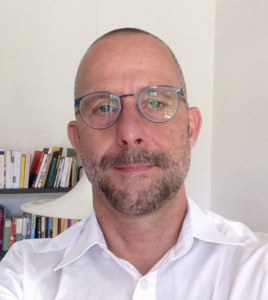
Associate Professor
Comparative Literature Program,
German, Slavic, Semitic Studies,
& History of Art and Architecture
University of California, Santa Barbara
Education
B.A. University of London, 1987
Ph. D. Oxford University, 1991
Major Areas of Interest
European modernism, with an emphasis
on the European avant-gardes, postwar
and contemporary literature and art
(especially in Eastern and Central Europe), and media history.
Most Recent Book Publication
The Big Archive. Art from Bureaucracy. Cambridge/Mass.: MIT Press, 2008 (forthcoming) [Table of Contents]
[Introduction]
Select Publications, 1994-2007
Books
ed. (with Anna Brodsky and Mark Lipovetsky), The Imprints of Terror. The Rhetoric of Violence and the Violence of Rhetoric in Modern Russian Culture, Vienna: Wiener Slawistischer Almanach, Sonderband 64, 2006.
ed., Leidenschaften der Bürokratie. Kultur- und Mediengeschichte im Archiv. Berlin: Kadmos Verlag, 2004
ed., Gøgøl: Exploring Absence. Slavica Publishers, Bloomington, 2000.
Figures of Memory and Forgetting in Andrei Bitov's Prose Frankfurt/Main: Peter Lang, 1996
Articles
"La Bureaucratie de l¹Inconscient. Le début du surréalisme dans le bureau." Le surréalisme et l¹économie du rêve. Wolfgang Asholt / Theo Siepe [eds.], Paris: Octon (in press)
“‘Passer à l’Acte’: The Police in the Office.” Klaus Mladek and Wolf Kittler (eds). Police Forces: A Cultural History of an Institution. Boston: Palgrave [2007, forthcoming]
Cellularbürokratie: Pathologie als Ordnungswissenschaft, am Beispiel Rudolf Virchow,” Christoph Hoffmann/Caroline Welsh [eds.], Umwege des Lesens. Aus dem Labor Philologischer Neugierde, Berlin: Parerga, 2006, pp. 276-290
[«Stalin as Medium: On the Sublimation and Desublimation of Media Technologies in Stalinist Culture“]. Sovetskaja vlast’ i media. Hans Günther and Sabine Hänsgen [eds.], Sankt-Peterburg: Akademicheskij proekt, 2006, pp. 51-58
Vom Umhertasten in der Kunst: El Lissitzkys Demonstrationsräume zwischen Labor und Büro. Inge Münz-Koenen/Justus Fetscher [eds.], Pictogrammatica. Die visuelle Organisation der Sinne in den Medienavantgarden (1900-1938), Bielefeld: Aisthesis Verlag, 2006, pp. 197-217
„Die Poetik des Anti-Denkmals: Schriftskepsis, Registratur und graphische Methode,“ Susanne Strätling/Georg Witte [eds.], Die Sichtbarkeit der Schrift. Munich: Fink, 2006, pp. 139-152
L’image électronique dans l’espace: Jeffrey Shaw avec Ilya Kabakov, Jean-Pierre Balpe/Manuela de Barros [eds.], L’art a-t-il besoin du numérique? Paris: Lavoisier, 2006, pp. 35-55
"The Homeless Symptom: Archive and Trauma in Boris Mikhailov," in: Anna Brodsky, Mark Lipovetsky, Sven Spieker (eds.), in The Imprints of Terror. The Rhetoric of Violence and the Violence of Rhetoric in Modern Russian Culture, Vienna: Wiener Slawistischer Almanach, Sonderband 64, 2006, pp. 191-212.
“Hidden in Plain View: Fotoatlas und Trauma, am Beispiel von Boris Michailow.” M. Streisand/S. Flach/Inge Münz-Koenen [eds]. Der Bilderatlas Im wechsel der Künste und Medien. Munich: Fink, 2005, pp. 71-96
“Verspätete Zustellung: Anmerkungen zur Post- und Nachrichtentechnik in der russischen Literatur des frühen 19. Jahrhunderts, am Beispiel von Michail Lermontows Ein Held unserer Zeit (1840)." Bernhard J. Dotzler/Sigrid Weigel [eds], Fülle der Kombinationen: Literaturforschung und Wissenschafsgeschichte, Munich: Fink, 2005, pp. 17-34
"Die Ablagekur, oder: 'Wo Es war, soll Archiv werden': Die historische Avantgarde im Zeitalter des Büros". Trajekte 5 (2002), pp. 23-28
“‘ll y a’: Kabakovs Weigerung, den Mülleimer zu leeren. Bürokratie und feedback in der Installation Der Mann, der nie etwas wegwarf.” Schriften-Dinge-Phantasmen. Literatur und Kultur der russischen Moderne I. Wiener Slawistischer Almanach, Sonderband 54 (2002), pp. 393-430
"Ekstasen der Kritik ohne Objekt: Zur verworfenen Moskauer Aktionskunst". Kultur. Sprache. Ökonomie. Wien, 2001 [Wiener Slawistischer Almanach Sonderband 54], pp. 289-310
"Revolution als Wiederholung: Minimalismus und Konstruktivismus am Beispiel des Würfels". Mirjam Goller, Georg Witte [eds.], Minimalismus: Zwischen Leere und Exzeß. Wien, 2001, pp. 305-328
“Getting the Real to Respond: Repetition, Pawns, and Missing Encounters in Dostoevsky’s Crime and Punishment.” Gedächtnis und Phantasma. Festschrift für Renate Lachmann, 2001, pp. 471-481
"'Zywe archiwa': pamiec publiczna , zaszczepianie tresci, kontekst (Libera, Haacke, Wodiczko)" [Polish]. Teksty drugie 4 (2000), 7-27
“Orthopädie und Avantgarde. Dziga Vertovs Filmauge aus prothetischer Sicht (Der Mann mit der Kamera).” N. Drubek-Meyer/J. Murasov (eds.), Apparatur und Rhapsodie. Zu den Filmen des Dziga Vertov, Munich: Fink, 1999, pp. 147-169
“Stillife as Fetish: Zbigniew Herbert Between Torrentius and Malevich.” Indiana Slavic Studies 9 (1998), pp. 61-78
"Lokalni kontekst me vubec nezajima". Umelec 7 (1999), p. 5 [Conversation with Boris Groys, Czech]
"The Logic of Collecting: A Conversation With Boris Groys". Artmargins 1998 [www.artmargins.com]
“Postmodernism as ars oblivionalis: Amnesic Travelling in Andrei Bitov and Roland Barthes.” Die Welt der Slawen 2 (1995), pp. 220-250
“Gogol's ‘via negationis’: Aisthesis, Anaesthesia, and the Architectural Sublime in Arabeski.” Wiener Slawistischer Almanach 34 (1994), pp. 115-142
"Ilya Kabakov, der Herr der Fliegen: Der Moskauer Konzeptualismus und die Speicher". Berlin-Moskau [exhib. Cat.]
"Living Archives, Grafted Monuments: Memory in the Public Sphere" (Libera, Haacke, Wodiczko)". Tympanon [www.tympanon.edu]
Most Significant Invited Lectures, 2000-06
2006. “Zerstreuende Versenkung: Walter Benjamins unterbrechende Sicht auf die historischen Avantgarden.” Walter Benjamin Kongress, Berlin, Germany
2006. Conference Hybridity in Russian Culture, University of Constance, Germany
2005. «Das Bild hinter dem Bild : Die off/on Ästhetik der historischen Avantgarde » / University of Regensburg, Germany
2005. «Die Avantgarde als Experimentallabor». Conference “Spuren der Avantgarde: Theatrum Machinarum” / Free University, Berlin, Germany
2004. “L’image numérique dans l’espace: Ilya Kabakov avec Jeffrey Shaw » / Conference L’art et le numérique / Cérisy-la-Salle, France
2004. “Der Surrealismus im Büro : Verwaltung der Kunst und Kunst der Verwaltung.” Conference on «Surrealism Today » / University of Düsseldorf, Germany
2003. “Rodchenko’s Files or: The Birth of Modernism from the Bureaucracy”. Symposium on Alexander Rodchenko / Berkeley Art Museum, Berkeley, CA
2003. “Archives of Modernism” / Museumsquartier Wien, Tanzquartier/Factory Season Project, Vienna, Austria
2003. “Sublimacija i de-sublimacija medij v stalinizme: kontrol ‘i vlast’“ / Conference Sowjetmacht und Medien / Bielefeld University, Germany
2003. “The Archeology of the Modern Archive”. Lecture / Museum of Contemporary Art at Ujazdowski Castle, Warsaw, Poland
2003. “El Lissitzkys Demonstrationsräume für abstrakte Kunst: Zwischen Museum und Büro” / Conference Bild und Schrift im historischen Wandel / Center for the Study of Literature (Literaturzentrum), Berlin, Germany
2002. “Die Ablagekur, oder: Wo Es war, soll Archiv werden: Le Corbusiers Bürokarteien”. Conference “Kinetographies” / Humboldt University, Berlin, Germany
2002. “Schock und Ablage: Le Corbusiers Bürokarteien”, Workshop Zwischenräume / Max-Planck Institute for the History of Science, Berlin, Germany
2000. “‘Symptômes sans abri’: archives et trauma”. Conference La rupture dans l’art / Musée du Louvre, Paris, France
2000. “L’amnésie topographique. L’Atlas de Gerhard Richter”. Symposium Voilà / Le monde dans la tête / Musée de l’Art Moderne de la Ville de Paris, France
Conferences Organized
Science as Navigation: Leonhard Euler's Journeys. A symposion on the occasion of Euler's 300th birthday. UCSB, November 30, 2007.
The conference investigated the central role played, in the life and work of the Swiss mathematician Leonhard Euler (1707-1783), by the description, calculation and analysis of sites or places (topoi). The conference looked at Euler's activities in a multitude of disciplines as building blocks for a comprehensive topology of culture founded on exact science and the ideals of the Enlightenment.
Calculating Images. Representation by Algorithm in Science and Art
. This international conference (held at UCSB March 4-5, 2005)
investigated the digital image at the interstice of art and the
sciences. Since the beginning of the 1990s, when researchers focused on digital
photography, the digital image has not found the attention it deserves.
We therefore want to begin with a series of basic questions that place the
digital image in the context of other digital and non-digital imaging
technologies.
On Computable Texts and Images: Markov's Bequests. Conference at the Helmholtz-Zentrum für Kulturtechnik at Humboldt-Universität, Berlin (April 2003). Organized by Philipp v. Hilgers, Sven Spieker and Wladimir Velminski. In 1913 the Saint Petersburg (Russia) mathematician Andrei Andreevich Markov (1856-1922) published a short treatise that was nothing short of revolutionary ("An example of statistical study on the text of `Eugene Onegin' illustrating the linking of events to a chain"). In his treatise Markov presented a method for using probability in the analysis of texts. Markov's method consisted in viewing random series of numbers as "chains" that are temporally dependent on each other. Today this method is called Markov Process and can be found in many computer-based applications in the areas of science, art, and the economy. The fact that Markov put his theories to the test by using literary texts is far from coincidental. Already in the 1920s Markovs analytical methods were adopted by linguists such as Roman Jakobson and in this way they entered the realm of culture and aesthetics at an early stage. In this context, the symposium addressed the question as to what extent the members of the Russian avant-garde assimilated Markov's advanced mathematics. Beyond that, the symposium's objective was to elucidate the process that led to the subordination of literary texts and the traditional arts to mathematical calculation.
Packrats and Bureaucrats: Study in the Archive. Interdisciplinary Humanities Center, UC Santa Barbara, February 5-6, 2001. The phenomenon of collecting, in various institutional contexts, has generated enormous scholarly interest across a variety of disciplines in recent years, especially in philosophy, mediastudies, and in art history. Despite this interest, the archive, its specific histories and media or institutional contexts are all too often taken for granted, insufficiently contextualized, or assumed to cover any activity of collecting. Archives are not, or not simply, collections, and their historical specificity, means of storage, and reproductive (mnemonic) strategies have to be carefully evaluated. Held in conjunction with Ilya Kabakov's residence at UCSB.
|
|